Tactical Theory
Juego de Posición under Pep Guardiola
An analysis of the Juego de Posición football philosophy as it was applied by Pep Guardiola in his second season with Bayern Munich, set against the principles that define positional play.
Part of the Tactical Theory section — explorations of football philosophy and the systems built by elite coaches.
The premise
14 out of 19 trophies were won in his time at FC Barcelona. 4 trophies out of a possible 6 were won in his first season with Bayern Munich. This piece analyzes the Juego de Posición football philosophy of Pep Guardiola in his second season with Bayern Munich.
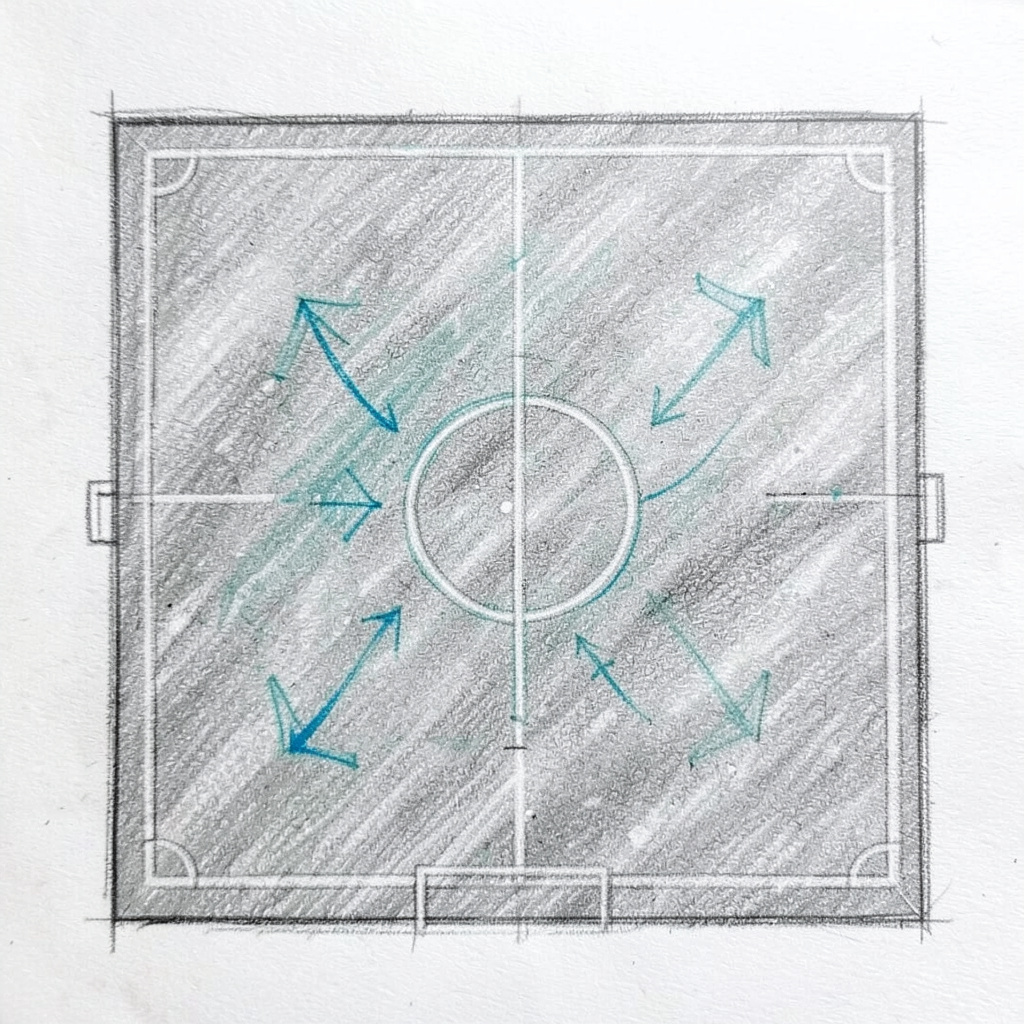
The Italians know it as Giochi di Posizione, the Dutch as Positiespel. Different names describe the same underlying idea: a team that controls the ball, the pitch and the spaces between the lines, turning the field into a network of short, angled options rather than a series of long, direct passes.
The Principles of Positional Play
The core ideas that sit beneath Guardiola's Bayern side, examined one by one.
Principles of Positional Play
Positional play begins with the ball. Possession is not an end in itself but the vehicle for creating a superior numerical advantage in a specific area of the pitch. From there, each principle follows from the previous one.
Width and depth
A team in possession must stretch the opponent, occupying both the wide channels and the space between the lines so that no defensive block can be shifted across without leaving a gap behind it.
Support in possession
Every player needs a nearby option. The distance between teammates is measured in passing angles rather than metres: the closer the support, the more angles open, and the harder the ball can be pressed.
Positional play in a high block
Once possession is lost, the same principles operate in reverse. The team must counter-press immediately, so that the opponent cannot build their own positional structure against a disorganised defence.
Structure first, then the ball follows from it.
Pep Guardiola
Guardiola's reading of these principles is the subject of the piece. The Italian and Dutch terminologies describe systems that have been tested in Serie A and the Eredivisie; his version at Bayern Munich was built on the same logic, translated into the language of the German league.
Conclusion
What the philosophy asks of a team, and what it asks of the people in it.
Juego de Posición is not a set of gestures but a way of understanding the field. It requires players who recognise the same picture, who hold their width and their depth without instruction on every touch, and who accept that the shortest pass is rarely the most intelligent one.
Guardiola's second season with Bayern Munich showed the philosophy in its second competitive environment: the same principles, different players, a different league. The analysis of that season is the point of departure for the wider Tactical Theory work on this site.
Keep reading
More match breakdowns, tactical theory and football history are published on the Adin Osmanbasic site.